Showing posts with label Picasso. Show all posts

Monday, March 31, 2014

ART HELPS HEAL THE VIOLENCE WE INFLICT

Post 1 of a three part series on Art, War, and Healing

I started this thinking it would be one post, but as I delved into my thoughts and did more research I realized it would be more than one post.  Our world seems in turmoil at the moment, perhaps no more than in the past, but with instant news from all corners of the world it seems worse than ever before.  We are overwhelmed by constant news of violence, trauma, and conflict globally.  I think it is worth us looking at how we as artist portray violence, grief, turmoil, death, and our propensity as a species to have wars and kill each other. It is also worth our while to look at how art not only reflects what is happening, but also how it we need art to help to heal and make sense of our world.  Join me in this look and be feel to contribute at any time in our discussion. 


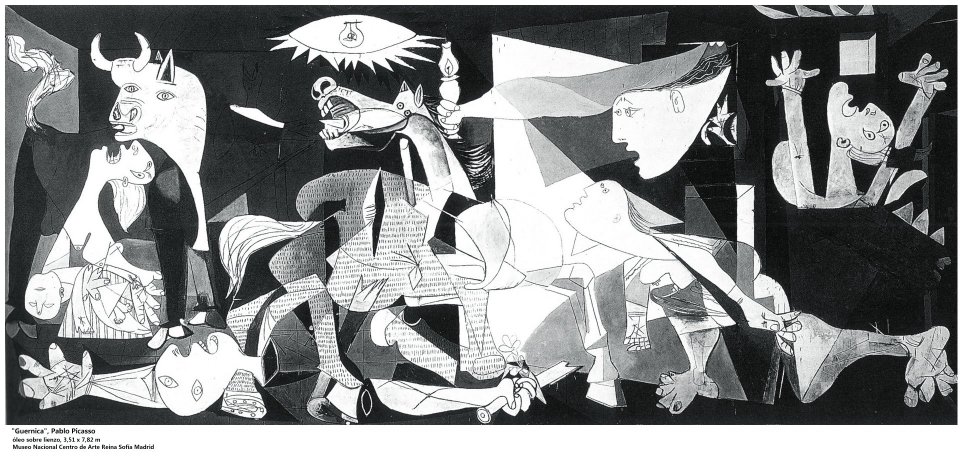
Picasso's Guernica will alway be a poignant work of art that lives in my mind. When I first studied art history in college and we would see two to three hundred slides a week, I don't think I grasp more than knowing Picasso's piece was a masterwork to be memorized.  With experience in life, the piece has become a defining seminal art work for the violence man inflicts on man…the inhumanity man brings to other men. I think it portrays not only the horror of war, but senselessness of war in which women and horses and children are killed as well.


Guernica by Pablo Picasso     from google image, only for education
By photo journalist Eddie Adams from google image for education only

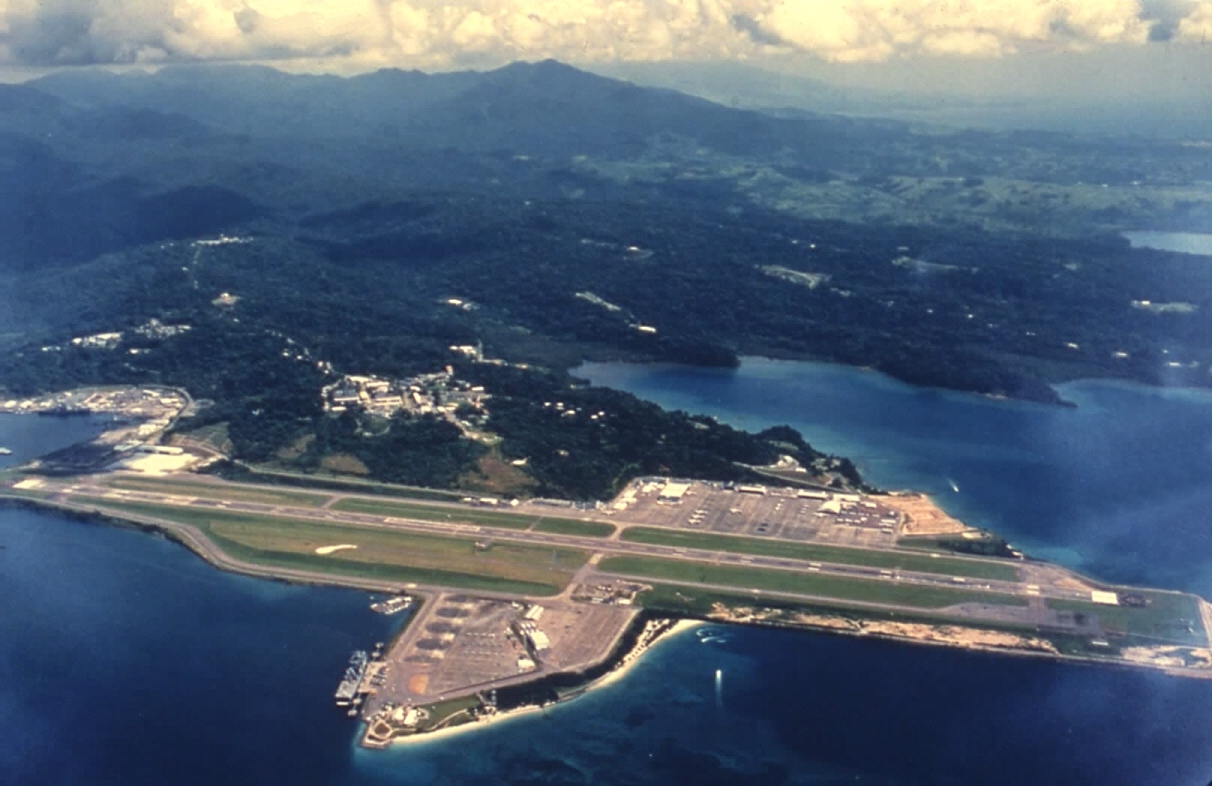
The Vietnamese war changed my view of war and those I saw affected by it.  I was a young teacher assigned to Subic Bay Naval Base teaching art to 4-6th grades.  We were a main support base for the arms for the Navy for the Viet Nam war.  The first year I arrived we were still an active war base.  I met men going to war, and men who came back for R&R.  There were naval officers and enlisted, marines, and civilians all on the base.  The base sat at the edge of the jungle.  All kinds of ships, carriers, and boats were constantly going in and out of port.  There was also a Naval Air Field called Cubi Point which flew missions to Viet Nam.

Cubi Point Naval Air Field   Subic Bay, Philippines
 The base was not large like Clark AFB, but a smaller community of people, so everywhere you went you were surrounded by people involved in war one way or another: t
he dinning halls and restaurants, the movie theater, the base beaches, the BX and

Subic  Bay Naval Base with Carrier at Port
Commissary, the library.  One way or another you met the men going in and out of conflict.  Some needed to tell their stories and some couldn't talk about what they experienced, but just needed to spend time with someone from home.  Many men I met and befriended did not come back from war.  I ate dinner with a fraternity brother of my brother at Cubi point, a wonderful meal and visit.  He was a pilot who was on his way to Vietnam, his plane was shot down not long after and he was killed.

The worse thing about the Vietnamese war was that it was so unpopular in our own country. The men that served did not all volunteer, it was a time of the draft and when  your number came up you went whether you wanted to or not. 

The war was not backed by congress and the nation was in uproar over its purpose and need.  As a result these soldiers, who were like any soldiers in any war exposed to violence and horror, were not respected nor loved by their country.  Today it is hard to imagine. The military is so well thought of, and highly respected today. People are thankful for the their service and sacrifice. 


Letters from home tell about how the country disrespects the soldiers and the war,
this soldier feel utterly rejected and alone.

 from google image for education only


 Not so, during the Vietnamese war.  These men were looked down upon, and shamed upon returning home.  Not only were they shamed, but because of the confusion and turmoil at home and in congress about the war, the men were often left in the field without adequate back up. We were being out fought by a lesser army, and out thought.  Our young men from the fields of Georgia, Alabama, Mississippi, and small towns from West Virginia to Texas died in those jungles and the ones who survived came home to a nation who were ashamed of them and detested them.  The war they were told was necessary, but the country became to believe the war was unjust and rejected it and the men who served there, fairly or not.
  
Australian  troops pinned down in battle    artist unknown    from google for education only
if you know this artist I would like to give him credit.


These men have had a life time of healing to do, not only for dealing with the horrors of war, but managing the shame and disrespect a nation inflicted on them when they came home.  In another war they would have come home heroes, but not this one….and they would suffer and they did. But they were not the only ones who suffered.  Both sides suffered, the North Vietnamese and the land, the animals and all of Vietnam.  People get caught in wars, they just happen to live where the conflict is, whether it is Egypt, Syria, Afghanistan, Iraq, Cambodia, or Korea. No one wins in a war, people die, people are maimed, animals are injured or killed, the land is scared and everyone is marked psychologically forever.  
Viet Nam War           The horrors of war                                    from google for education only


Art helps us see the inhumanity, as in Guernica and the work of the photojournalist below.  Art also helps us to cope with the event, the drama, the pain, and in the years that follow the memories that will haunt those involved for a life time.  Some of the pain was inflicted upon us, and some of the pain is what we inflicted on other human beings.  When we look up close and personal at war and what we did to other humans, whether enemies or friends, it is just too difficult for us to accept that we may be responsible for such horror and violence. 


Art work by Blum


This image below of a little naked girl running down the road being bombed shocked the world of the senseless violence of war that befalls the children caught in the conflict.  These children's village was hit by a napalm bomb which scorches the Earth and every thing on it where if lands.  These children are running from their village that has just been bombed and the young girl in the center has had her clothes burned off of her.  The napalm is like a hot jell that sticks to the body and continues to burn. 


Vietnamese Children running from their village after being  napalmed by US Forces

The story for this young girl does not end here.  I met her years later at a conference in Montreal for Death and Dying Issues( ADAC).  I was with a friend who was attending the conference and was able to attend Kim's incredibly moving speech.  The next day we were eating breakfast in the hotel cafe and Kim walks in by herself.  We invited her to eat with us, which she did.  She then told us her most incredible life story which I will share with you in the next post.  It is a dramatic story, that takes a lifetime to unfold, and it is worthy of us spending more time telling Kim's story.


Kim with her child and showing the scars of the napalm bomb
 In the following post we will continue Kim's story, photo journalists of the Vietnam War, Art related to the war from both sides and at home, and art aimed at healing those who endure the violence of war.

Sunday, February 9, 2014

Picasso Quote

"Others have seen what is and asked why.  I have seen what could be and asked why not."
Pablo Picasso"Metamorphoses of the Human Form: graphic works, 1895-1872

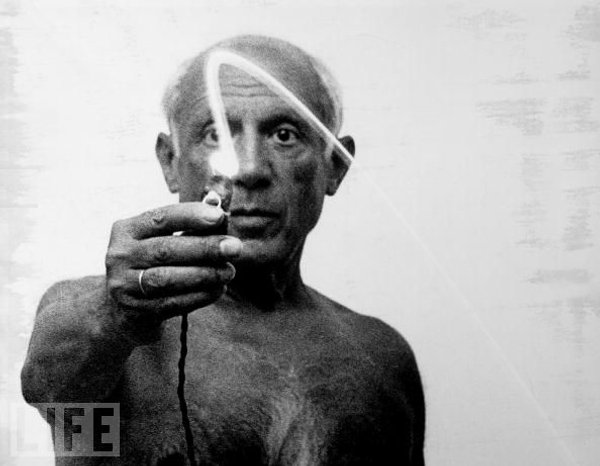
Pablo Picasso Life Magazine Cover                                                        from google image for education only


Friday, January 17, 2014

LADDERS AND CONSTELLATIONS


MIRO

Elizabeth Gordon  at Miro Museum in Barcelona      

         photo by Ann Suggs
 Miro is one of many artists that didn't capture my attention in college like some of the rock star artists of the era. I wasn't much enamored with Dali or Picasso or the Surrealist.  Perhaps it was because art history was so boring and taught so poorly.  I am not sure, but memorizing 200 or more slides a week, with a test at the end of the week with 25 or more unknown to place in a style and time period, wasn't my cup of tea.  Yes, I can recognize many art works and artists, but what can I tell you about their lives and what influenced them to paint in their day.  Art history should be taught in a much more interesting and connected way.  I have hear there are programs like that, just not where I attended.  There was once a program on Public Broadcasting called Connections, and it did just that, it connect political, social, environmental and commercial influences on art.  It was fascinating and the way I had wished I had been taught in art history.  
Later as an art teacher I would do more and more research on artist when I was teaching different units for my students.  A double learning took place, one for them, and another for me.  I love learning and I love research, so it was a win-win situation.  
The more I learned about Miro, Picasso, and other artists I had not studied in depth about in school, the more I wanted to know more.


Ann Suggs and Elizabeth Gordon         Barcelona   Gaudi's House


On a trip to Barcelona, I visited Gaudi's architecture that changed the way I viewed the way I thought building must be designed like.  I did not know they could look as if they were melting, and did not have to have hard angles. 

 On the same
trip, I discovered there was Miro's Museum  sitting there on a high hill overlooking the harbor and city. It such a magnificent view and reminded me so much of my home, Tampa.  It is a city on a bay as well.  I thought it would take an hour or two max to see the museum but
, I stayed there all day and left at closing.  I was blown not away by, not only, Miro's art, but also his thinking about art and creativity.
Below is a video from you tube about Juan Miro you may enjoy.


Today a friend sent me this link to a slide show walk through of Miro's museum and work.  I thought I would include that here for you.  Take a walk with Miro, look at his work, listen to his discussion of his artist process.  Look at the time he, Picasso, and Dali lived in, all working in Southern Eastern France and North East Spainish during relatively the same time period  in an area called Catalonia.  Click on this link now for your tour.  

Miro, Picasso, and Dali lived in the same area and painted at similar times.  Miro and Picasso lived through the Spanish Civil War, WWI and WWII.  At different times they fled Catalonia for Paris and then when the Nazi's occupied Paris, back to Spain.  


Guernica by Pablo Picasso                    from google image for educational purposes only


Picasso's Guernica was painted in response to the bombing of Guernica during the Spanish Civil war. 


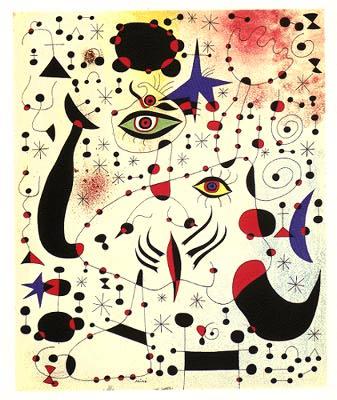
One of the series of Constellations by Juan Miro  
   from google educational purposes only


 The painting became an iconic statement for peace.  Miro hid in his imagery of his Constellations and Ladders references to war the times.  That is why it is so important to look at all the influences of a given era that art is produced in and what effects the artist.  In some eras it could be the invention of a new art media like acrylic paints, or the extinction of a mollusk that once thrived in Europe, or the inability of flax to grow in England.  

Tuesday, December 3, 2013

IN SEARCH OF THE ORDINARY

DO WE LIVE OUR LIVES IN THE DETAIL OF EVERYDAY OR DO WE LOOK UP AND SEE BEYOND? 


Georgia O'Keeffe's Flowers                                  from google image for education only


Zen would tell us to focus on one act, to perfect it so well that it becomes a spiritual act in itself. But most of us are just trying to go to work, but groceries, feed the kids, get the car fixed, go to the dentist, or decide if we want paper or plastic at the check out counter.  The details of life can overwhelm us, mesmerize us, so we just go on in an kind of survival mode. 

Picasso's Bull Sculpture made from a bicycle seat and handle bars

 But we have those moments when we look up, we look beyond, and we imagine.  Sometimes these moments come out of the blue, as an epiphany, and other times it is one of life's dramas that awaken us: the illness or death of a loved one, a major illness of our own, a world event of war or natural calamity and the like.  I can point to my moments as you can yours, but they stop us in our tracks and slap us awake.  
La Momma Morta from Philadelphia Story
as Tom Hanks character faces his own death
due to the aids virus devastating effects
Sometime it is an aha moment and sometimes it is an oh no moment. Which ever it is, we see and think differently..we are almost hyper aware.  This is where the arts step in..where art is created, where imaginations are enlivened, where music scores are written and opera scores sung.   It is where inventions come to life and visionaries see the future. 


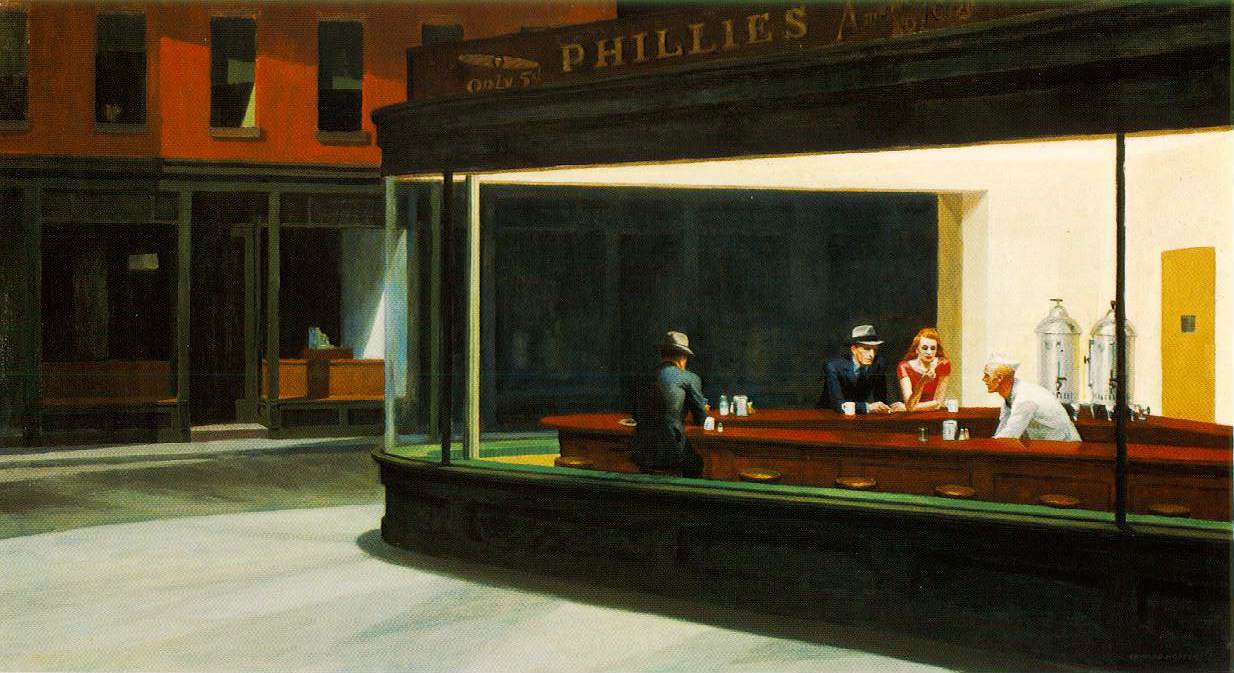
Edward Hopper's Nighthawks                           from Google image for education only


How do we translate the ordinary into another language…how do artists find another vision…how do some people see the same thing so differently?  


                     Andy Goldsworthy, Environmental Artist

That is what we are exploring now.  Lets look at a few more artists elevating the ordinary to a fine art!


Andy Warhol's Marilyn

Saturday, October 19, 2013

IS AFRICAN ART THE NEW TREND?

        ZAK OVE              NEW ART TRENDING


                    London based artist of Trinidadian heritage

In an article I read recently from MSN, the art world believes that wealthy buyers in Africa are wanting to buy and support local, home grown artist.  Some of the most recent shows in London have supported that trend. A look at some of the artists that are being looked at, is worthy of our interest as well.  African art and art style has been of interest to artist for a long time.  Picasso based a good bit of his ideas of cubism and other art on the African style and culture.  Europe long looked at the world of African art with interest, but always with the eye of of being Eurocentric:white artists, copying African style. 
Zak Ove  Changing World            from google for education only

One of the new artists of interest is Ove.  He is London born, but has a Father of Trinidadian heritage and an Irish Mother.  In his younger years he went on movie sets and did filming with his Father.  His interest are in video, photography and now developing into fine art. He delves into the subject of a white dominated world and its effects on black people and culture.  He looks at the European centered world in contrast to the African struggle to attain stable government, respect, and financial stability.

Zak Ove   London based Artist
google image only for educational purposes

"The trend is spurred by wealthy Africans supporting home-grown talent and European collectors searching for the next big thing. Several London galleries focused on African art have opened in the past few years, the flagship Tate Modern has set up an African acquisitions committee, and this year's sale of African art at the auction house Bonhams has passed the 1 million pound ($1.6 million) mark.

London's Somerset House is hosting the 1:54, the British capital's inaugural contemporary African art fair, this week. And the mood there is buoyant.
"People are caring more in the press, collectors are opening their doors, and museums are showing more African artists," said Mariane Lenhardt, whose Seattle-based M.I.A Gallery is selling fierce-looking, nail-studded busts by London-based sculptor Zak Ove."
Bonhams auctioneer Giles Peppiatt, whose annual Africa Now auction took in a record 1.3 million pounds ($2.1 million) this year, said he has never seen so much interest." Msn 

Zak Ove    London Based Artist                         from google image for educational purposes only
If I were still teaching art I would certainly choose Zak's work to build a lesson or series of lessons around.  His multi-media approach lends to the ability to do many projects with children and his topics are excellent to build tolerance, understanding and acceptance.  There is a decided lack of coverage of African and Black artist in art history and in the training of young art educators.  I think it is important that we correct this, and pay attention to the art of all people and culture.  The art world had been long dominated by European and Western art, it is time to be more inclusive. 

Monday, October 7, 2013

EVERYONE IS CREATIVE!

Creativity , the emergence of the original and of individuality, is found in every living cell. This flow and interweaving of individual differences is, by definition as well as by discovery the process of emerging originals, creativity. Creativity is in each one of us.  
Creativity was in each one of us as a small child.  In children creativity is universal.  HENRY EYEING

Eyeing goes on to say he believes it is non existent in adults and  what has happened to this enormous human resource? He goes on to say that is the question of the age.  This book Creativity and Cultivation was published in 1959.  The book is a compilation of various minds of the day from their individual disciplines.  It is amazing to go back in time to the thinking of the time and see how much had not changed and how much remains the same.  Picasso's quote reminds us well, if one could remain a child (keep that creativity and innocence) one could be a better artist. 

Friday, May 31, 2013

Quotes on Art to Motivate and Inspire. We, as artists, need to feed our souls!


“When I say artist I mean the one who is building things … some with a brush – some with a shovel – some choose a pen.” ~Jackson Pollock
“The main thing is to be moved, to love, to hope, to tremble, to live.” ~Auguste Rodin
“Life is the art of drawing without an eraser.” ~John W. Gardner
“Art doesn’t have to be pretty. It has to be meaningful.” ~Duane Hanson
“To draw, you must close your eyes and sing” ~Pablo Picasso
“Art enables us to find ourselves and lose ourselves at the same time”. ~Thomas Merton
“Go and make interesting mistakes, make amazing mistakes, make glorious and fantastic mistakes. Break rules. Leave the world more interesting for your being here. Make. Good. Art.” ~Neil Gaiman
“The earth has music for those who listen.”  ~William Shakespeare
“Art is not a thing, it is a way.” ~Elbert Hubbard
“Art is when you hear a knocking from your soul — and you answer.” ~Terri Guillemets
“Art reaches its greatest peak when devoid of self-consciousness. Freedom discovers man the moment he loses concern over what impression he is making or about to make.” ~Bruce Lee
“I am interested in art as a means of living a life; not as a means of making a living.” ~Robert Henri
“We dance for laughter, we dance for tears, we dance for madness, we dance for fears, we dance for hopes, we dance for screams, we are the dancers, we create the dreams.” ~Albert Einstein
Read more at:http://skinnyartist.com/150-amazing-quotes-to-feed-your-creative-soul/


Ai Weiwei                   photo by Elizabeth Gordon

Friday, October 12, 2012

A Site You Will Love As Artists and Art Lovers
Look up any artist anytime, pull up visuals of Van Gogh, Monet, Picasso, Pollack and thousands more....
Arts On Line(click)


Tuesday, August 21, 2012

The world today doesn't make sense, so why should I paint pictures that do?  ~Pablo Picasso

Picasso                            from google image

When we think of the time Picasso and Miro and others painted it makes sense he would feel this way.  Unrest in Europe, a world war, economic depressions, and suppression of artists.  Miro learned to use a language of symbols and Picasso learned to focus in on cubism and other aspects of art. But as we see in his mural of Guernica he could not always refrain from reacting to the horrible senseless violence around him.


Miro                                  from google image

Monday, June 11, 2012

PICASSO, DEATH AND HUMAN SUFFERNING

Picasso was terribly effected by his friend Casagmas' death.  Casagmas was a Catalan artist and constant companion of Picasso in Paris. Casagmas committed suicide over a love affair gone awry. For Picasso it was the loss of a great personal friend at a young age.  

Pablo Picasso    Death of Casagmas  from google image

"Picasso continually attempted to exorcise the pain and guilt he experienced as a result of the death of Carles Casagemas; this struggle with mortality, human suffering, and pain was a constant theme throughout the continuing decades of Picasso's art. Many of his Blue Period works deal both directly and allegorically with these conflicts. Throughout his life, Picasso sought redemption from the issues of human mortality by creating a vast world of sexuality, strength, and virility. The specter of death, and his need for redemption and survival, haunted Picasso into his 90s." from Neurosurgery News


Pablo Picasso             La Mort de Casagmas
from google image
Picasso went into a deep depression after the death of his friend.  It was then he started painting with green and blue paint and his subject matter depicted mans struggle with mortality and suffering and pain. 


Picasso's Blue Period
A time depicting suffering
human suffering and depravity


La Vie                Pablo Picasso
from google image

Looking at death, suffering and pain in our lives is not easy.  Losing people when you are young and the promise of life is taken away so cruelly seems terribly unfair.  We cannot always reconcile these feelings within ourselves.  When a life is lost to suicide there is almost always a feeling that if I could have done something, if I could have reached out more, then I could have saved my friend.  Losing a loved one to violence leaves us often with a deep feeling of anger and bitterness.  How could anyone have done such a thing, how can people be so cruel and unfeeling? Death and suffering are never easy for any of us and yet we will all experience it at some point in our lives. 
Picasso takes his grief over his friends death and develops a language of symbols he uses over and over again the rest of his life.  The depression over his friends death also builds a deep compassion for suffering he sees in the human condition around him.  Picasso could have become bitter and angry, he could have remained in a severe depression, but instead he used the lesson of personal suffering into that of exploration of suffering for all humans.

Artist/ Translator of the Human Condition

Artists incorporate the human feelings into their art work. 


 Whether it is joy, sorrow, sadness, horror or our own inhumanity towards each other, the artist is a sensitive who takes in the myriad of feelings, images, sounds and sensations that have no words to explain them.  Then we interpret them into paintings, sculpture, poems, songs and plays.  In this way we help explain the human condition so others can make sense of their world and emotions.  There is great beauty in this world, there is great sadness, and there is inexplicable horror and violence. It is the stuff life is made of.   It is what took Picasso into his Blue Period(click) and why he created the masterpiece Guernica. 


Sadness, Anguish, Grief


Loss, Death, Pain

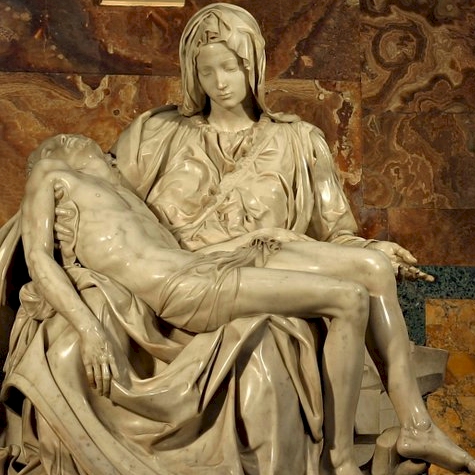
Michelangelo's Pieta from google image
Pain, Horror, Madness


Munch's  The Scream from google image
 Michelangelo's Pieta captures a tender sadness of a Mother's loss of her son, Munch's Scream incapsulates the absolute feeling of horror, pain and terror, and Hiroshige's Wave shows the power of nature over man.


Violence/Death/Mans Inhumanity to Man


Detail from Picasso's Guernica  from google image


I thought we would touch on these themes and look at how artists capture these themes for us.


These past two weeks I have been in New Orleans, as you might have noted in my previous posts.  I am here to help my partner with her Father who is dying of  cancer that moved into the bones.  He is in the last stages of cancer and the decline has been rather rapid.  It is so difficult to see someone you love so ill and watch their body begin its final transition.  Seeing  the emotions of friends and family grapple with their emotions and watching him cope with pain and  sadness is so wrenching.  It brought to mind master art work that best depict such sadness and pain.  
Also in the time I have been here in New Orleans there has been an unprecedented rash of senseless violence and murders in a city mired in poverty and recovery from the disaster of Hurricane Katrina.  Again as I was horrified by the senselessness of the murder of the young and impoverished.  One such murder was that of a 5 year old girl at a birthday party and a 33 year old Mother of 3 driving three blocks away.  Boys playing men shooting at each other over rivalries in broad day light.  A city in turmoil with senseless murders and violence. 
It is not only New Orleans, but much of the United States and other countries are resorting to solving problems with guns and force. 
The world seems more violent these days and violence more senseless.  More Mothers grieve the loss of their children than should.  Boys that can never become men, and little girls that will never see their first dance.  How do we cope with such loss, sadness, pain, and terror.  Lets take a closer look at artists who have done so.

Sunday, March 25, 2012

Interesting Facts about Pablo Picasso

Self Portrait by Picasso


Picasso's had name had 23 words in it.  He was named Pablo Diego José Francisco de Paula Juan Nepomuceno María de los Remedios Cipriano de la Santísima Trinidad Martyr Patricio Clito Ruíz y Picasso. He was named after different saints and family members. "Picasso" is actually from his mother, Maria Picasso y Lopez. His father is named Jose Ruiz Blasco.

Monday, October 17, 2011

Major Picasso Exhibit in China

PICASSO IN CHINA

Photograph by April Gordon

For my friends in Asia, you might want to check out this exhibition. It is to be one of the largest shows of Picasso's work. Below is the article posted regarding the show.

Biggest Picasso exhibition in China opens

SHANGHAI — Paris's Picasso museum on Monday opened the biggest exhibition of works by the renowned Spanish artist ever to be staged in mainland China, organisers said.

The three-month exhibition at the China Pavilion at the former site of the Shanghai World Expo features 48 paintings spanning the life of Pablo Picasso, who pioneered the cubist movement, as well as sculptures and prints.

"We have been trying to find a way to open a show in China," Anne Baldassari, director of Paris's National Picasso Museum, better known as the Musee Picasso, told AFP in Shanghai shortly before the opening.

"It's a way for us to educate two or three generations of the Chinese public."

The Musee Picasso is closed for a nearly two-year renovation, allowing several cities around the world -- including San Francisco, Sydney and Toronto -- to display pieces from the collection.

Sponsor Tix-Media, a privately-owned Shanghai exhibition company, said it cost nearly 1.0 million euros (around $1.4 million) to bring the works to the commercial hub.

Picasso was first introduced to China in 1983, when then French president Francois Mitterrand opened an exhibition of 25 of the artist's works in the capital Beijing.

The Shanghai exhibition spans all periods of Picasso's long career, from a painting when he was just 14 to one completed a year before his death in 1973. It includes paintings such as "The Barefoot Girl" and "The Dream".

The works to be shown in Shanghai were just displayed in Taipei. The museum is trying to find a venue in Beijing before the exhibition moves on to several other Asian cities, Baldassari said.

Proceeds from the global tour will help offset the more than 50 million euro renovation of the museum, which will triple the area for the collection, she said.

Saturday, October 15, 2011

An Affinity for All Thing Spanish


One of my childhood memories was of the art at the Las Novedades and the Columbia. El Greco and Goya's work adorned the walls of the Novedades. I loved El Greco's dramatic use of lighting and elongated limbs of his human figures. The Columbia brought in painted tiles to decorate the foyers and seven dinning rooms of the world's largest Spanish restaurant. The Valencia also had wonderful landscape paintings by early Spanish artists. More recently the Dali Museum was founded in St. Petersburg, Florida across the bay. What a wonderful resource to add to the richness of Spanish influence and culture in this area! Visiting Dali's museum in Figures and his home in Cadaques in the Catalan region was a lifetime event. What wonderful artist Spain has produced! Gracias Espana!

Related Posts Plugin for WordPress, Blogger...