Showing posts with label Monet. Show all posts

Friday, April 18, 2014

LOOKING AT LIFE ON BOTH SIDES NOW!

WE WERE RIDING THOUGH ASHEVILLE
 AND IT STARTED TO RAIN
A COLD FRONT COMING THROUGH


 I WAS WAITING IN THE CAR
 WHILE ERRANDS WERE BEING DONE
 AND GOT A LITTLE BORED. 

I LOOKED OUT THE CAR WINDOW 
AND HOW THE RAIN DISTORTED THE VIEW.  


 I LOVED THE WAY IT MADE ME LOOK 
AT FAMILIAR OBJECTS IN AN ABSTRACT WAY


 IT TOOK ON SOME THOUGHTS OF MONET, 
AND OTHER FRENCH IMPRESSIONIST AS WELL,

MONET

CAILLEBOTTE


IT IS SO IMPORTANT TO TAKE TIME WHEN YOUR INNER ARTIST SAYS " HEY, I HAVE AN IDEA".  EASY TO IGNORE, EASY TO MISS A MOMENT THAT CAN BE LONG GONE, AND NOT BORN.  

STOP 

TAKE TIME

 CREATE

 BE IN THE MOMENT 

THINK 


PS.  Photo's taken with little point and shoot Lumix by Panasonic.  Love this little camera. It has a leica lens and 20x zoom, but fits in my pocket.

Saturday, November 30, 2013

ARE THINGS TOO COMMON FOR US TO REALIZE IT IS ART!?

IN THE ORDINARY LIES THE EXTRAORDINARY!

As we move through our world the myriad of images we see on the way to work, or the way to get groceries or run all our mundane but necessary errands, or to get the kids from school, or one of those miserable rainy slick days when we get stuck behind a slow moving school bus can be really astonishing.  It is part of our everyday world, and just in the repetition it becomes ordinary and not exceptional in our minds.   I think as  artists we are trained to have heightened observation skills and be highly sensitive individuals.  Most people think think art must be pretty, refined, in  focus, and elevated beyond our everyday world.  But is in the everyday artists often find their muse.  If you look at these photo's below with me I will take you through my thinking as an artist.  

Photo's by Elizabeth Gordon   Asheville North Carolina  Newfound Rd 
 It is a typical fall day, a front is moving through and it is rainy, slick, overcast and raw, damp, cold.  I am on my way to do several errands and need to be out on a day I would rather be home reading by the fire.  As I am driving along something captures my attention and I reach for my camera.  I am not even sure what catches my attention at this point, but my senses are overwhelmed with stimuli.  Though just a typical rainy, fall day, the light reflects more on the road, the swish sound of tires hitting puddles at a high speed, the thump, the thump of the window shield wipers.  The greens are darker, and all the whites, reds and yellows brighter.  The air feels heavy, but not the same heavy of a Florida thundershower, it has a different quality with the smell of dampened fall leaves.  The rain on the car window distorts and mutes images, visually my world is different. 

Photo's by Elizabeth Gordon   Out of focus road and farm fences
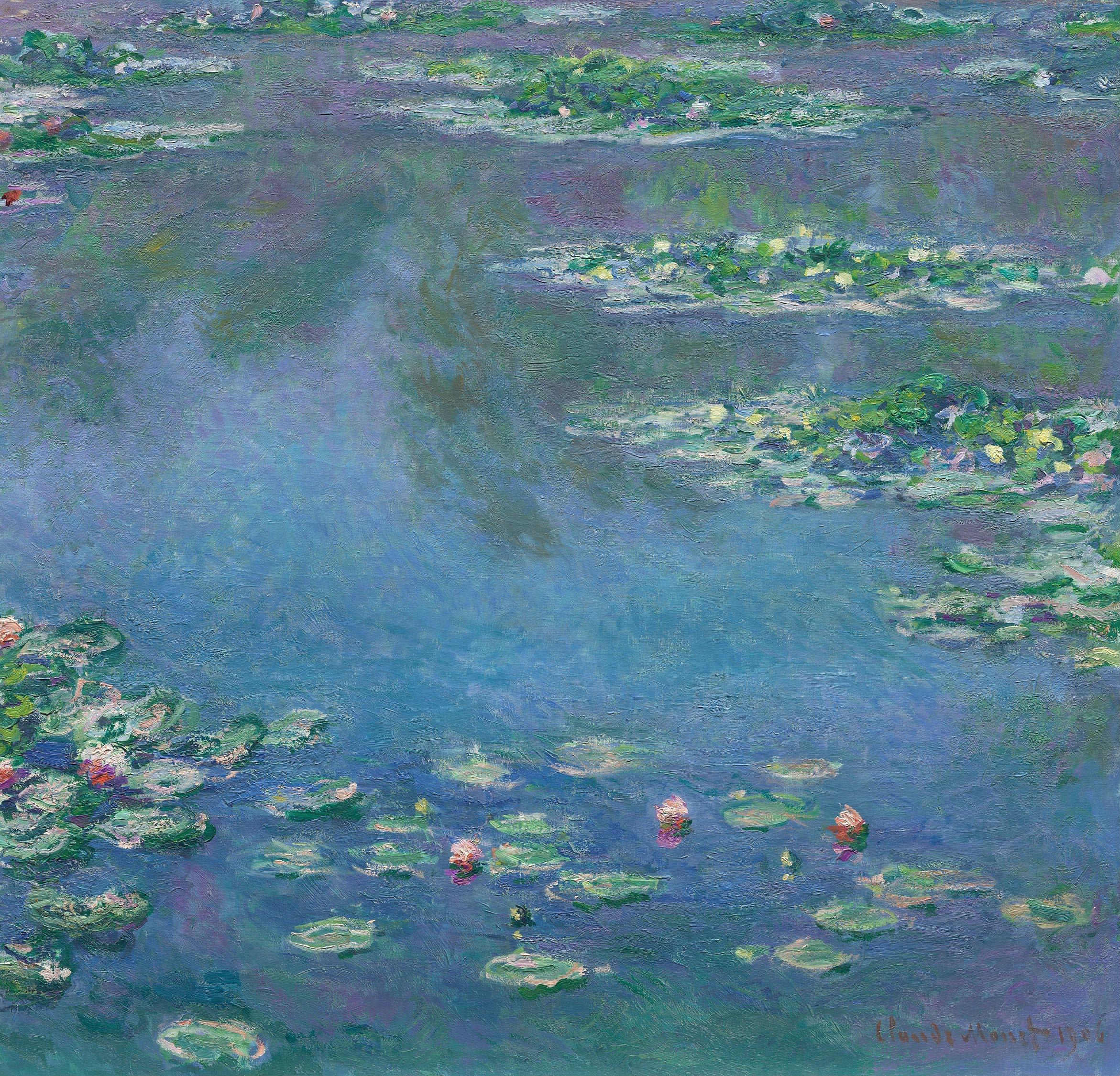
I love to take out of focus pictures.  I always think of Monet at the end of his painting life, with cataracts and barely able to see, painted larger and enjoyed his ability to see differently.  
Monet Garden's
I have near sightedness that is very severe.  If I take off my glasses I see much like the photo above.  I actually love that, that I can see in focus and out of focus.  I think there is a strength in not focusing…a straining to make sense of what one is seeing.  The shapes are simpler not complicated by detail, and the blurring softens the image and colors.  I have often thought of doing a whole series of work out of focus and call it "Seeing Clearly Now".  


Looking through the window shield wipers at the farm at the bottom of my mountain road.
He is not the neatest farmer in the world and I get to observe his farm daily.  Look at how the yellow
trailer jumps out at you.


Photo's by Elzabeth Gordon


  School buses fascinate me for a variety of reasons.  As an art teacher of 37 years, they were a part of my daily life.  I love the colors, the bright yellows, the red and contract of black.  Did you know the yellow and black are decided by government and enforced by law…there is a specific color, called school bus yellow, that made specially for the nations school buses..that was decided in the early to mid 1900's.  
*School buses become icons for us, for our common experiences of attending school; traveling from youth to adulthood, from bullies and teasing, to the shear conceptual concept of transportation from one sense of place to another. 
  And for me as a teacher and thousands of school children in the summers, it was a sight we didn't want to see, because it inhibited our freedom.  Or the opposite every turn is bringing you closer to home,  a hot pot of soup waiting and Grandmother's hugs waiting at the door.  Her purple umbrella  she holds so lovingly in the damp rain, the smell of her old fashioned soap envelops you in warmth and love as she hugs gathers you in her arms when you come home from the city school whose culture is so different from your rural mountain upbringing.  


*Imagine a Tryptic of three school buses, from larger to smaller, closer to further away accompanied by three images of driving through the rain with distorted images…imagine I provide audio of the swish of tires on wet road, and the clapping of the window wipers clearing the rain away.  What if I added a muted radio, echoing and the sound of small children in the car…can I create an installation of an American experience?


School buses in our experience are part of our ordinary mundane world.  They are not sexy in the Madison Avenue sense of the world , they are not exciting, or beautiful in a everyday sense.  But for an artists they can be all of those things and more! 

*Imagine if you are a film maker the story you could weave around the photo's, they could become stills in your movie.  You can add characters, plot, and imagination…it can be a horror film, a drama, a thriller, or sad reality program.  
Imagine if you are a writer the plot you could enter twine with these images.  A lonely shy child returning home to an abusive father and the road home looks foreboding and horrifying, each turn takes you closer to your worst fears.

* Imagine if you are a musician, and you hear the clap, clap, clap of the window wipers, and you take the beat and write a score from it.  Or you add the sense of moving in sound or score, the feel of transformation.  And then you add mood to the music. What would it sound like, would it be happy, sad, moving, dramatic, quite, foot tapping..what would you create?


 \
*Imagine you are a painter and you want to capture the motion and the light…you want the blur…you want it to feel impressionistic-just a sense of what you are seeking and feeling-then what would you paint.  If you were Van Gogh would you tie yourself to a tree as the wind moved the tree in the brisk fall winds, would you paint day after day repeating the same painting in different light and different times of day and seasons?  If you were Picasso would you focus on the movement by making all sides being seen at the same time to make it as real as possible, that is becomes abstract?  


* Imagine you are a dancer or choreographer, how would you interpret the movement of a school bus in wind and rain, how would you move you body or a group of dances to recreate the mood of this school bus moving through time…what would Martha Graham Dancers do?  


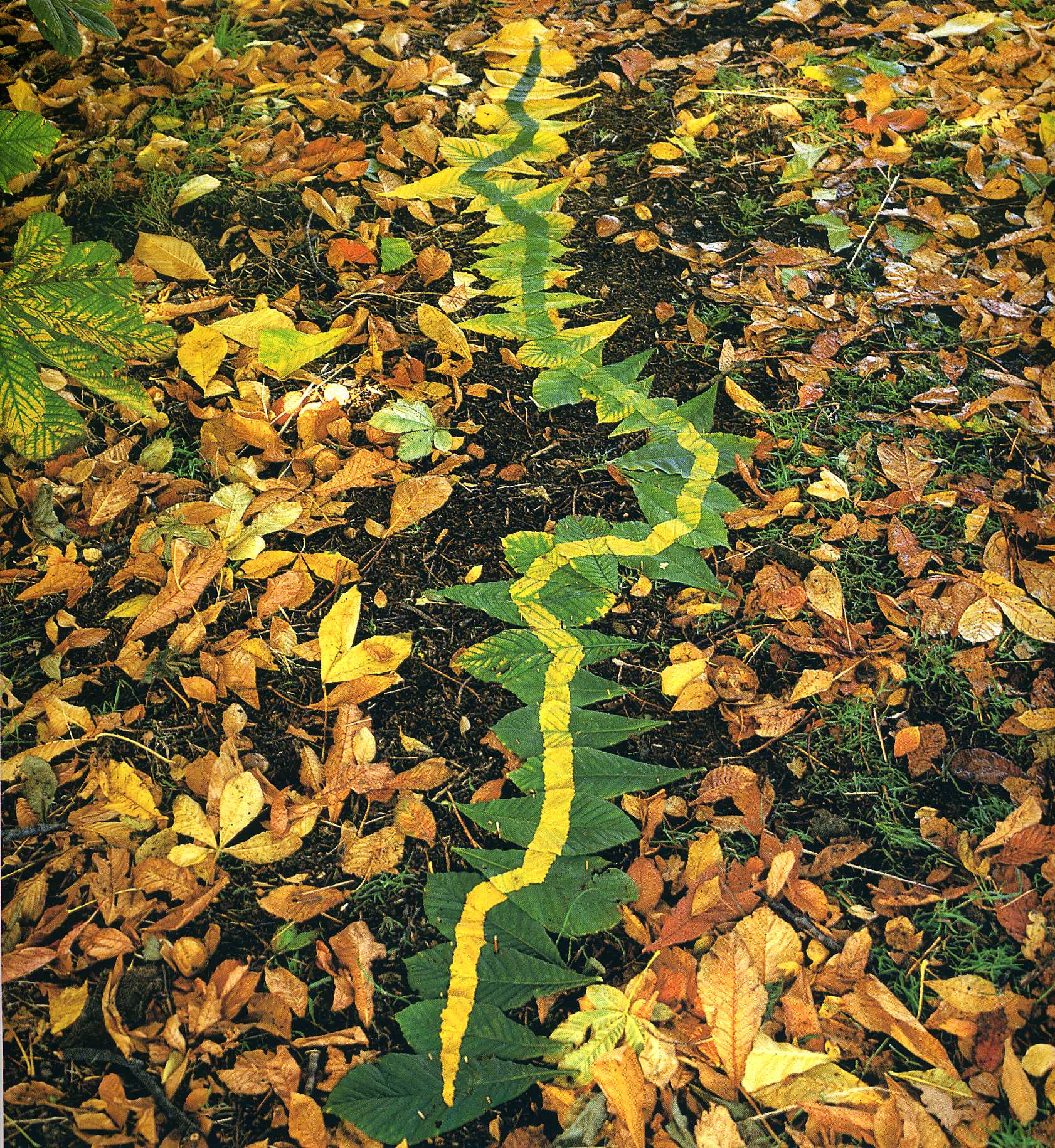
Imagine You are a nature sculptor or environmental sculptor, like Andy Goldsworthy,
Andy Goldsworthy
how would you use this road to recreate the gravel and leaves, and brown grasses and twigs and logs to become a work of art that amazes but that is not permanent.  What would you do?


photo's by Elizabeth Gordon Hayes Cove
I wanted to take you through a bit of how an artists might take something that is mundane to most of us and turn it into a world of art, how they see the world differently.  I hope I have helped you do that and perhaps come up with some ideas of your own.

Sunday, October 20, 2013

WHY YOU SHOULD TRY TO UNDERSTAND TO THE ART YOU HATE!

I know what I like!

Art is in the eye of the beholder.

A child could do that! 

These are all expressions one hears about art and often it is in response to art that we either don't understand or that we have a strong reaction to.

Art is constantly evolving and changing as well as peoples reaction to art. TODAY Impressionism is still one of the most popular art forms, but only a short time ago it was rejected by the art critics and public of the time.  Impressionists had to hire their own space to show their work to even have it shown to the public. Before Impressionism art was less colorful and more exacting in realistic replication.  It was called sloppy, junk, and blurs in the newspapers in Paris and art collectors snubbed Impressionists artists of the day. So why the strong reaction of the critics, the public and the news papers...why were people so stunned by this new art style?

If anything, what came to be called Impressionism was a natural consequence of confluent forces, social, technological, and economic, as well as aesthetic.


Monet's Water Lilly's      Impressionism      
from google only for the purposes of education


"Change was inevitable. Whenever art becomes institutionalized and rigid in terms of what is and isn’t permissible, artists are going to seek new solutions to old challenges. The history of art is a continual response to changing social conventions, political events, and cultural influences, and the second half of the 19th century in Europe was especially volatile.
Among other things, technology was developing rapidly and dramatically. Industrialization had taken hold, and the steam engine was becoming practical, facilitating rail and ship travel. Most important to the history of art, photography had made enormous strides since its introduction by Niepce and Daguerre in 1839,2 and it contributed to the rise of Impressionism in a surprising way.
For the Impressionist painters photography could tell them what something looked like, but not how one saw it.
It’s easy to think of photography vs. painting in terms of reality vs. a transformed version of reality, but that’s deceptive. For the Impressionist painters photography could tell them what something looked like, but nothow one saw it. Early black and white photographs were a record of what was at the moment the photo was taken, but it couldn’t come close to replicating the experience of seeing." From the article by  by John Crowther  


Neo-Classism was the accepted art of the day
from google image for education only

So we evolve from handprints on caves to Egyptian body image to Da Vinci's anatomically correct bodies, from the Greeks' perfect proportion to raised perspective to 3 dimensional.  We learn more, we invent something else and things change along with peoples ideas about art.  Even artists disagree about what is good art and what is not.  We ask our selves the basic question of what is art.   Duchamp's r.e. Mutt presented confronted us with that dilemma.


Marcel Duchamp, Surrealist questioning " What is Art"

So do you have to like something you do not like, No.  But you do need to ask yourself why...why do I react to this?  Is it because I can 't understand it or is it another reason?  To have an open mind, to be curious and to react are what artists hope for in their public.  

Artists basically reflect our times, values, and questions back to us, that is their basic function...shaman of their times.  It may be an in your face selection, a pleasant non threatening reflection, it may ask you to think or feel or experience, but art does ask something of us.  Man will always replicate his world and environment in visual elements, as well as, reenactment as drama, and in music.  We constantly seek to understand the world around us and our experiences in that world.  Art is the first language of man and since time began we seek to increase our vocabulary.
by Elizabeth Gordon, Rms

Tuesday, January 29, 2013


Monet     Seine River                                                 google image, for educational purposes only
Monet believed that Turner's painting Impression, Sunrise gave its name to the Impressionist Movement.  A view that Monet did of the Seine River in Le Havre compares to Turner's and Monet's own work on the Thames River. 


Turner   London Fog                               from google image for educational purposes only

Monday, December 31, 2012

NAME YOUR FAVORITE ARTISTS OR ART WORK

Lets start the new year naming our favorite artists or art work. 
 I will go first, then you can add yours.

Charles Demuth       Engine Number 5


Rauschenberg  Monogram
Claus Oldenburg  French Fries
Van Gogh        Starry Night
Calder             Circus
Cornell            Everything he did
Monet             Water lilles 
Duchamp         Re Mutt
Dali                 Psychedelic Toreado 
Picasso           Bull with Bicycle Handlebars
Demuth          Engine Number 5
Johns              Orange and Green American Flag


Sunday, December 30, 2012

WHAT IS ART?

Cave Paintings of Lascaux     from google


This is worthy of a discussion and has been for as long as man first picked up a stick of charcoal to draw.  From the days of the cave man when drawings of bison and deer were depicted on the walls of caves man has been involved in the act of making things and expression.  The caves of Lascaux, France did not show stiff nor ultra realistic drawing, but drawings that show movement and a knowledge of oneness with nature.
 I am sure there are people today, if these drawings were taken out of context, would call them too fluid, not realistic enough, a limited color pallet and so on. Every period of art, every movement of art has been met with controversy of some kind. From ancient Egypt to Italy, to France, to Asia and the Middle East, culture upon culture, age upon age, the needs and styles of art have changed.


Egyptian side view with frontal eye                     google image

I think another part of this discussion is why does man need to draw or create? Why did the cave man feel the need to pick up a piece of charcoal, mix earth and chalk to recreate their hunts?  One could have just told stories or sung songs.  In some cultures drawings become real things that have a life of their own.  Each culture has a need to create, to reflect upon itself and as our technology has changed so has our art.


The Mona Lisa by Leonardo Da Vinci 
from google image

Artist once were chained to their studios because paints in a tube were yet to come and easels were not portable.  Colors had to be made and ground out, brushes were licked to a point by assistants, and there were periods where anything could become a base for a color, such a mold for green, or mollusks for an intense purple.  Whole villages died due to lead poisoning from the lead in the artists paints and assistants lips were distorted from pointing brushes loaded with lead.
The Greeks came up with perfect proportion, the ideal.  Leonardo dissected bodies to learn the true structure of a human to the risk of his own life.  Math came into play as Renaissance artists wanted a truer since of perspective.
Once the camera was invented there was not the need to record images for the sole sake of representation.  Now artists could take more leeway in interpretation, emotions, and experimentation. The art movement in Paris led us away from stiff dark colors, to emotion, light and movement. Impressionism moves forward with Monet, Renior, Van Gogh, and Degas.  How does the light seem, what is the emotional play through the artist to the subject at hand.  How can I show just the quick look of movement and light?


Monet's Gardens at Giverny, France
from google image

Then came harder times with violence, poverty and war.


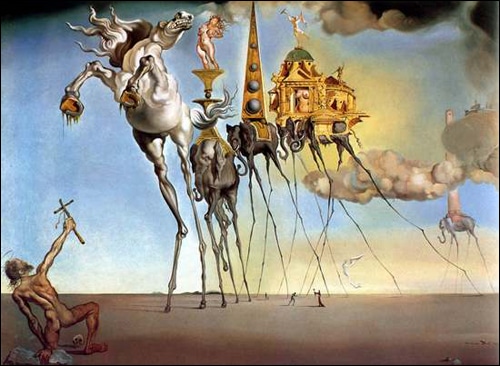
Salvador Dali                                                     Surrealistfrom google image


Dadaism was a reflection of a senseless time at the end of WWI that people questioned to the core of their beings the desperation of their times. Science and art often go hand in hand.  As Freud is questioning the meaning of our dreams and symbolism then surfaces art that presents symbols and the nature of the mind. Surrealism was not long to follow, then we begin to question again what perspective truly is as Picasso shows us a multi -dimensional person with the nose to the side and the eye looking forward. 

Picasso                  Cubism   google image

Cubism is born and we look at many things, not just people from a different view. We know objects are three dimensional, so what is realistic and not?  
And now we are at a time when Modern art often has a disconnect with people who view it.  So we must ask ourselves why is that?  What is it about our age and our culture that has produced art that seems is harder for people to understand?  As we are more complicated as a society, as we are more advanced as a civilization, and as our technology rapidly changes...our art reflects us as a people.  Art reflects the confusion of the time, the alienation people feel from a modern world that often leaves them in their wake of rapid change, and changing value systems.  I have oft heard it said that artists are the shaman of their times....we reflect our world back to our culture.  Modern art makes us think, asks us questions that are not simple, and rarely is a representation of the sake of representation.  


Andy Warhol                            Pop Artist


 The need is not there because we have cameras, computers, and the ever expansive flow of data.  As technology expands even further and more things become possible that seem beyond our imagination now...what will artists do with it?  They will create, that is what they do.  They will interpret our world for us when it gets to complicated to comprehend.  They will make us think deeply and help us to see things in a way we never would have.
 Should it always be pretty, should it always be easy, should it always be representational-I would put to you it should not be.  It would be to our detriment if it was.


Robert Rauschenburg      from google image


  Should it be ugly and hard to understand...yes, sometimes for that is how we are as a world and as people.  We would dishonor art to take away artists freedom to think and create, we would diminish art if we demanded artist only copy nature or people realistically and more so we would limit our growth as people and a civilization if we do not encourage our artists to experiment and grow and to envision what can be.
 If Gaudi had never envisioned architecture as if it were fluid and melting instead of angular, if Da Vinci had never dissected the first body, if Buckminister Fuller had never built the geodesic dome, if the cantilevered arch had never been invented, if Van Gogh had never painted starry night, and Michelangelo had never lay on a pallet painting the ceiling of the Sistine Chapel, if Picasso had never painted Guernica protesting the massacre of the Basque in Spain, and Pop art had never pointed out the mass commercialism of our times, the Eiffle tower was never built, and Frank Lloyd Wright had never picked up building blocks....our world would be poorer for it. Look about where ever you are, right now.  Now imagine if there were no art..the walls bare, the architecture non existent, the furniture no imagined, the halls of all the buildings blank..so signs, no nothing, just bare..that is a world with out art.
 I am not an art historian, but I have had many art history courses.  I am open to discussion and correction.  I think we should be open to a fascinating discourse on the arts.  Please feel free to add to the discussion.

Monday, November 12, 2012

Still Life with Napkins and Apples

Still Life 

This Photo was one of many I was taking around the mountain studio and I had not thought about it turning out particularly well until I was reviewing the photo's on my computer.  There is no enhancing of color, that is the way it looks.  Sometimes by accident you just get a great shot.  I love the richness of color. 
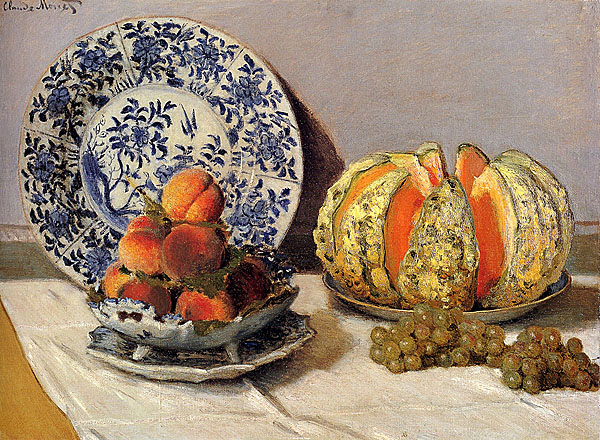
 It made me think about great still life artists of the past.  One I have always loved is Cezanne.  When I was in high school he was the very first artist I choose to study when we were ask to do a still life by our art teacher.  
And then there was Van Gogh's Sunflowers, again I was captivated. The term still life comes from the Dutch Stilleven meaning bits of fruit or flowers.  I also ran across a surprising piece when researching this for the post.  It is a still life done by Carivaggio in 1595.  I had never seen a still life of his before, only his paintings of people with the drama of pain and struggle. This was such a different look from him.  
So on one day for an artist's date as Julia Cameron calls it take out your sketch book or your camera and look for still life shots! Have fun, you just don't know what will turn up.  If you want to share your results here with us at Rabbit's Moon studio we would be honored.

photo by Elizabeth Gordon                                            Asheville Studio
Cezzane                               from google image
Van Gogh Sunflowers               from google image
Monet           Still lire with Melon   from google image
Carivaggio       1595          from google image

Friday, October 12, 2012

A Site You Will Love As Artists and Art Lovers
Look up any artist anytime, pull up visuals of Van Gogh, Monet, Picasso, Pollack and thousands more....
Arts On Line(click)


Monday, October 17, 2011

Monet, Manet, Toulouse, Gauguin, Niki Saint Marie, Cezanne, Matisse, Rodin,Corbet...the list goes on and

France,
How do we ever thank you for your contribution to the world of art! Your artists have influenced the world and other artists creations for decades and decades to come. There was a time the world trotted to Paris to be at the birth of many an art movement. Writers, poets, visual artist and actors as well have found their creative muse in Paris and other lovely French cities. Artist have wandered your countryside with journal and sketchbook in hand. So here is a nod and a bow to all your have given to the art world!

A few websites of interest.

I love the work of
Niki-de-saint-phalle. I will never forget the first statue I saw in the water fountain outside the museum of art. It was playful, fun, crazy and yet serious all at once. I absolutely fell in love with her work and set out to learn more about this amazing artist. Here is a website that we can all learn more about this wonderful women born in 1930.
http://www.bechtler.org/Collection/Niki-de-saint-phalle

Monet
Who could not love Monet? A trip to his gardens at Giverny in magical. I took a trip to Paris when I was teaching and my elementary art classes surprised me with the gift of a journal to write about my journey. On the outside was a Monet painting. I took pictures, interviewed staff, and walked the gardens in awe. The students and I had watch many films and one about a young girl whose dream it is to go to Giverny. The film takes us though the yellow dinning room where we meet his large family and see Japanese Woodblock prints(that his flower bulbs were wrapped in). We visit his large studio, where with failing eye sight, Monet paints larger and larger canvases. As I walked the gardens I thought I was seeing a ghost, a man who looked like Monet was standing on the Japanese bridge. I went up to talk to him, he was real. He was Italian and spoke little English. When the kids saw our picture together on the bridge, they were sure I had met Monet himself!

http://giverny.org/monet/welcome.htm

Cezanne

Cezanne was the first French artist I was ever aware of. I was in high school and though I always drew, I had been exposed to very little art in school. I was in high school and our teacher wanted us to do a still life. I looked at her books and discovered a still life done by Cezanne. Something about the painting struck me, perhaps the geometrical structure or the brush work. But, it was his work I chose to look toward for ideas. My interest in Cezanne lasted for many years, before I discovered other French artists.

Saturday, October 1, 2011

Giverny and Money

This was a video sent by an artist friend that a is quite nice and I thought I would share it with you. It is a visit to Monet's garden at Giverny.
Enjoy! If it is not clickable go to my websites column on the right and it will be clickable there.

//www.youtube.com/watch?v=9QdjMt7_fUo&feature=fvsr

Wednesday, September 7, 2011

THE BEAUTY OF DETAILS

Details interest me. An object or view can catch you attention, but then take a closer look and it becomes a whole other world of shape, color, pattern, and texture. This is a photo is a close up of a drainage spout that pours into a canal in New Orleans. This canal is near one that gave way and flooded the city of New Orleans during hurricane Katrina.


I find such beauty in nature and man made objects worn and changed by use and weather. There are colors that one could not recreate if one tried. There is a vignette of a moment captured by time and light. Later in the day, the water may not flow, the light will change the color of the leaves and mold, the water would reflect differently. The impressionist knew this, they painted light. Monet, Van Gogh, Degas, Manet and others knew this. They studied one field, on crop of trees, or vineyard at different times of day and different season.
The closer I look I see gorgeous red orange dust, silvery green, white, tan, dark greed, blue green and more...I see leaves that look like koi in a Japanese garden, the edges of the spout take on a feeling of a shell. Now I am feeling as if on the edge of a tidal pool looking down.
As I back away I see a delicate sculpture that speaks to me of Henry Moore and Nancy Graves.
I begin to see the possibilities in my own work, the what ifs. There is such beauty in this world if you take time to look, even in a drainage canal in New Orleans! Look around you, look down, now slow down and look closer. What do you see?

Related Posts Plugin for WordPress, Blogger...