Showing posts with label Thomas Hart Benton. Show all posts

Monday, May 20, 2013

Jackson Pollock As You Never Knew Him-No Drips!

Los Tres Grandes by Jackson Pollack  from google image for  educational purposes only
There was a time when "Jack the Dripper" did not do the abstract drip paintings on the floor that you may know him by.  Many people do not know about his time in the WPA(click) and the Federal One Project. He studied with other artists who would later become famous as well. Another artists you may know is Thomas Hart Benton.  From 1935-42 Pollock's work was very different artist than the abstract expressionist he became later.  He revered the Mexican muralist artists of the 1930's, one of which was Diego Rivera.  When you look at Rivera's art it is not hard to see the influence. 
Diego Rivera   Mexican Muralists  from google for education only


"Jackson Pollock, often considered America's greatest modern painter, was born on January 28, 1912, in Cody, Wyoming. He grew up in Arizona and California and studied art at the Manual Arts High School in Los Angeles, eventually studying with the painter Thomas Hart Benton at the Art Students League in New York.
Thoma Hart Benton  Work Project Mural

Pollock admired the Mexican muralists of the 1930s. These artists had a great influence on his work, particularly with regards to scale and social theme. Like many artists of the day, he found work through the WPA Federal Art Projects from 1935 to 1942. During these formative years of Abstract Expressionism, Pollock's role as leader came to be recognized. He had his first show at Peggy Guggenheim's gallery, The Art of This Century, in 1943. 

Pollock, who suffered from alcoholism and depression, underwent psychoanalysis for several years. His treatment fostered an interest in Carl Jung's theories of trans-historical archetypes that formed the basis of the artist's works, particularly from 1942 to 1947. 

In the late 1940's, Pollock began to develop the technique of "action painting." Placing the canvas on the floor, he used brushes as implements to drip paint. This moment marks the greatest Abstract Expressionist achievement – symbolized by the Drip and a rejection of the traditional figure-ground relationship, often referred to as the Allover. In this process, Pollock challenged the entire Western easel tradition. In 1949, Life Magazine, placing Pollock on the cover, asked "Is This the Greatest American Painter?" catapulting Pollock and the Abstract Expressionist movement to the forefront." from an article with the L&M Gallery  

Tuesday, August 28, 2012

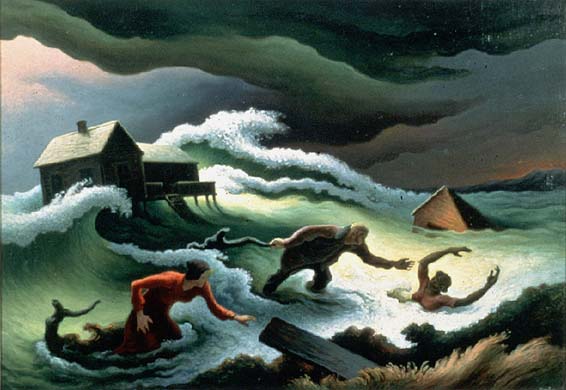
HOW ARTISTS LOOK AT NATIONAL DISASTERS

The arts are able to say things in ways we can't always express.  Sometimes it is a poem, music, theater, dance, or visual arts.  Lets look at how a sampling of visual artist look at Earth events that effect us as humans who inhabit this ever changing planet.  
 When I was five years old, my family lived near two rivers that converged in the town where we were.  Dams had yet to be built to protect towns on the lower ends of the rivers.  There was a great flood that game to the front porch of our house.  My Mother gave me the job of watching the floor furnace and if the water came in I was to come and tell her.  In my young mind I had an important job.  They delivered groceries by boat to us, but we were able to stay, the water receded and we were safe.  The picture is etched in my mind, as so many disasters world wide children and adults live through.  I have never tried to draw that moment...perhaps I should.  Perhaps I could show how large that furnace looked to me, and the view a child saw of water that lapped on the porch and seemed to go on forever.  What are you memories, what are your experiences with natural disasters?


Thomas Hart Benton  1951 Flood                                    from google image
Flood                 from google image
1953 Southwold  Flood by Frank Forward         U.K.   google image
Frank Forward    British Artist                                     from google image

1927 Mississippi Flood  by Cohen                 google image
Soapy Smith Flood of 1800's                             google image


Monday, October 24, 2011

The Beauty of the Laborer

Artists have forever found workmen fascinating for painting, sculptures, and murals. Diego Rivera and the Social Realist exalted labor and the laborer in their murals. Van Gogh studied the farm land and the varying play of light illuminating French men and women harvesting hay. Even when I hear Brando's cry, "Stella"!!! (from Tennessee William's play, A Street Car Named Desire). I can see the working class Brandon, muscular, rough and ready. The play was a study in culture clash, and the raw drama riveted our attention to the differences of classes. Thomas Hart Benton highlighted the American worker and labor movement. There is an innate beauty in labor. The sinewed muscles, the stance of the body, the dirt and sweat of wrestling with the land, and the creation that results from the laborers work. The perfect art model!


Red Harvest by Vincent Van Gogh


I have been enamored by construction workers, roofers, yard men, paint
rs, steel workers, and welders for a long time. On the way to work for many years I traveled across a bridge between two cities, one I worked in and one I lived in. My day started early, 7am or so. And my day would often end at 4 or 5pm, taking me across the bridge at the same time most construction trucks were taking workers to their jobs. Men were draped in different poses, half asleep, in open truck beds. The morning light playing on their hard hats, bandanna's, and leather tool belts was beautiful. The grittiness of faces sculpted by hard work and the environment engaging. Some days it rained, or the wind whipped strongly across the bridge, and some days it was ungodly hot with the sun bearing down on the tired workers that often fell asleep before they could get home.

Murals of the Detroit Industry by Diego Rivera


I was waiting in the car for a friend to pick up dry cleaning recently when I noticed construction in process and the workers next door. As we drove in and parked I became fascinated with one worker. His worn hat with its ocean blue hard hat looking a lot like the old twirling world globes we used to have in school. The yellow sticker, that looks like a red cross from afar and his sun scarf protecting his neck that looked very Middle Eastern all drew my attention. His stance is certain and his look of intent on his job was captivating to me. The workmen's jeans giving the Levi American look with chain and keys dangling, all these images screamed, "do art, do art, do something with this!" Everything is utilitarian, a no none sense look. The blue of the hat is repeated in the fire hydrant and the yellow offsets the yellow sticker on his hat. But also the bandanna that looks like a ponytail and the neatly crafted beard and goatee with dapples of light shinning through, all make for the makings of a future art work and the beauty of labor. How it will evolve I do not know, I only know it draws me like a magnate to want to know more, to want to use these images to create. Will it be a sculpture of mixed media or clay, will it be a collage, a print, a painting?....I do not know, nor do I know when my inner artist will say it is time to start this work.
I carry a camera with me at most times and build a visual journal of images. I capture moments of life or nature or just some odd thing I would forget later, but I loved at the moment. If you are an artist you know the call of doing art, your mind says...you can not, not do this...it comes as an urge, then a command. If you ignore it and let it slip away, you feel guilty you did not heed the call and create. An artist often creates because they must!


There are colors that I just love, especially the ones nature and weathering conditions create. The chalky blue of the fire hydrant, the muted hello with a scraffito of marks that seems to be a Earthy hieroglyphics of sort. Think about the world you live in, pay more attention to the details, value the worn and used...do not think of it is garbage or refuse, think of it as tended and messages left behind. Pay attention to the workers and laborers around you...look at how they stand, how they dress, and how their work molds their character. Then go back and look at other artist and how they interpret the nature of work and workers into their art. I welcome any comment or feedback that you may have about what draws your attention, what inspires you to create, and if you have the same feeling that you can not, not do art!
Related Posts Plugin for WordPress, Blogger...