Florida was a tropical heaven, not yet populated as it is today. There were tens of thousands more egrets, herons, osprey's and other birds. The waters were not yet polluted. The gulf was crystal clear and the natural springs bubbled up as they had for hundreds of years. Even when my family moved here from Mississippi in the early 1950's I can remember the sting in my nose of breathing in the salty air on Indian Rocks beach. Florida was truly its name, the Spanish word meaning flower. Oleanders and bougainvillea bloomed, citrus trees were ripe with fruit, and concrete had yet to be poured and tar slathered on the shell roads...the boom times would come, people would retire here by the hundreds of thousands each year...the waters would become mercy, the sea life disappear, and the birds would lose their habitats. But before all that would happened the Black Highwaymen would capture the pristine beauty of an environmental wonder.


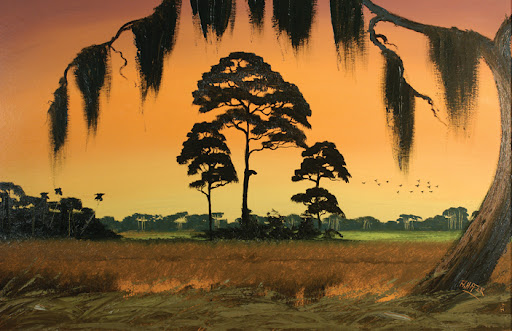


 Several years ago when I was teaching art, I did a school wide program on Florida that was centered around the arts. We had a professor from the University of Florida who came and gave a wonderful presentation on the Black Highwaymen. I wasn't sure how that would go over in an elementary setting, but the parents were fascinated and filled the auditorium. We also had a Seminole Indian princess who traveled from the Everglades Reservation and presented the history and culture of the Seminole Indians. We had a live Florida panther for the kids to see, you can imagine that was a huge hit for kids. The entire schools was decorated with drawings, paintings and interactive areas the kids created while learning about Florida history, culture and environment. Over a thousand parents and children attended the event that included visual art, dance, drama and food. The arts are a strong conduit for learning and disseminating information in a way children learn. It is being lost today in the rush to test, we have forgotten how to teach in the ways children learn best. I doubt any child who went through this unit on Florida will ever forget it and will tell their children. Experiental learning, problem solving and discovery are what the arts are....it is how brains are developed. Saving the arts in schools should be a paramount in every learning environ.
 Thank you Black Highwaymen for adding to the richness of Florida and capturing its unique beauty.